

I have more than ten personal projects. I also have a job, a family, two children and a persistent suspicion that the next calendar update will not include a third weekend day.
Powerful development tools made the constraint more interesting. I can write code faster, build an interface and investigate an unfamiliar component. I can run several tasks in parallel. Then they all return with convincing reports of completion. Congratulations: I now have an acceptance queue, and the slowest service in the system is me.
Around April 2026, the need became explicit: I wanted an autonomous development framework that would help me advance my products without turning me into a chat dispatcher. That need shaped LAF, my own autonomous development framework. The thinking started earlier, including Inteliar, a concept of specialized internal agents that employees could involve in their work. I will discuss the principle and management logic here, leaving corporate contracts and internal implementation details outside the article.
This is not a claim that ten products can be completed in one weekend. It is about choosing worthwhile work, delegating a bounded task and accepting its result without self-deception. Some projects should honestly remain idle. Occasionally their architecture even improves as a consequence: at least nobody rewrites it every evening.
Faster coding did not solve the portfolio problem
When implementation was expensive, it imposed a natural limit: I could not build everything by hand. Now it is easy to start more than I can thoughtfully finish. An agent’s ability to produce another screen does not make that screen useful to the product.
Each project has its own commitments, data, users, state and cost of failure. One needs a blocking defect fixed. Another needs a hypothesis tested before development expands. A third needs several pages of writing that will clarify its purpose better than another service. Meanwhile, context cannot be reconstructed every time from the owner’s memory and twenty messages saying “you know what I mean.”
I saw three separate bottlenecks: choosing the work, preserving its context and verifying the outcome. A model accelerates individual actions within that process. The process itself exists only when we define it.
From Inteliar to a personal development process
What interested me in Inteliar was access to the right specialization: analytical, engineering or research. Not a universal conversationalist equally confident about everything, but a participant with a purpose, relevant materials and bounded authority.
Applying that idea to my own products was natural. But saying “you are now an architect” does not create an architecture function. The role needs an input, an expected artifact, a quality criterion and permission to challenge the original request. Otherwise several agents congratulate each other on excellent work. Corporate culture successfully reproduced. The product is still pending.
For me, LAF connects an objective, a task queue, isolated execution, checks and delivery to the owner. I set direction and permitted actions. The system helps follow the accepted queue, preserve decisions and continue after a stop. It is my own evolving tool, not a promise of unrestricted autonomy in any repository.
Practice · role contracts and task contracts
A role matters when it changes the work. An analyst clarifies scenarios and constraints; an engineer implements; a reviewer looks for discrepancies; the owner accepts the product outcome. One tool can perform several roles sequentially. The number of models speaking simultaneously is not a maturity metric.
| Contract element | Meaning | Example for a small change |
|---|---|---|
| Objective | User-visible change | Repeated confirmation must not create another request |
| Input | State and permitted context | One branch, a recorded revision, synthetic scenario |
| Scope | What may change | Confirmation module and relevant checks |
| Constraints | Actions outside authority | No production release, billing or access changes |
| Artifact | Concrete deliverable | Diff, checked commit and test evidence |
| Acceptance | Observable behavior | One request after two taps; stale preview rejected |
| Limit | Resource and stopping rule | Bounded attempts; stop on an unknown external effect |
| Handoff | The human decision | Accept the change or identify a specific discrepancy |
A good contract need not be long. Fixing a label may need a few precise sentences. A schema change needs migration, compatibility, recovery and checks against existing records. Risk and uncertainty determine the specification’s depth, not enthusiasm for completing a template.
Fresh eyes are not automatically independent truth. Several agents can share the same false premise and reinforce it. Tie verification to something external to their agreement: a user scenario, data, an executable contract or a separate measurement. A vote among three LLMs does not replace running the application.
LAF’s April records already contain work on task queues, stopping after repeated failures, checks and context preservation. That matters more to me than a neat product birthday. The need evolved through actual failure classes: lost state, repeated work, evidence attached to an outdated revision. A framework should address those errors rather than merely give them a common interface.
What I keep doing myself when an agent writes the code
I now do much more hands-on development. Tools help me investigate defects, produce summaries, implement changes and propose tests. But I write and revise the skills, interaction rules, system instructions and direction of work myself. This is where professional judgment becomes an operating contract. “Make it good” is not one of its acceptance criteria. I checked.
A skill here is guidance for a particular kind of work, with examples, references and a definition of completion. It does not retrain the model’s weights. Changing an acceptance rule changes the agent’s working environment. That distinction matters: I can read an instruction, compare revisions, revoke it and evaluate it against the same tasks.
Consider “restore a deleted editorial post.” My specification must preserve the wording and revision history and cancel pending delivery. Restoration returns the material to the editor; it must not suddenly publish last Tuesday’s post. A beautiful trash interface that later broadcasts its contents to subscribers is an expensive button animation.
The acceptance scenario is concrete: save → queue for the future → delete → restart the service → restore → verify that the text survived and delivery did not restart. I separately test a race between deletion and dispatch. Some state transitions should never depend on a model’s judgment. Transactional application logic owns them.
My earlier Inteliar idea is not a story about having invented everything while the market failed to understand. I invited colleagues to explore specialist agents together, but did not turn that idea into a joint launch. Perhaps I did not explain the value convincingly enough. Perhaps I spent too little time selling it. Selling an idea is part of a manager’s job; I cannot assign that failure to everyone else.
There are comparable directions in the market now. Grok Bot, for example, presents agents as participants in a team’s workflow. That offers a useful user-experience comparison, not evidence of identical architecture or a claim of priority. My practical question is whether someone will trust my product with a second task after using it for the first.
By my own estimate, many of my projects are 90–95% complete. The remaining work includes things a new user encounters first: a clear entry point, documentation, a coherent interface and recovery after failure. My estimate is therefore not a measure of readiness for unrestricted production use. I can understand a product deeply and still explain it badly to a first-time visitor.
And yes, I sometimes burn out. My family and sleep are not spare compute capacity. If an autonomous framework merely lets me start five more projects and interrupts me constantly, it has automated my overload. A useful LAF must help me finish work and stop at the right time.
First choose what may occupy the weekend
A project list is not a portfolio plan. A plan includes limited capacity, dependencies and a decision about what we are not doing yet. I start with commitments and expensive risks: someone already relying on a result, a defect blocking use, or a short experiment capable of cancelling a large unnecessary investment.
Then I select a few completed outcomes. Not “work on Planograph,” but “verify the task-move scenario and accept or reject the change.” Not “do some book work,” but “finish this section’s argument and test it against an objection.” An action with an ending can fit a bounded calendar.
Calculation · ten projects, twelve hours and one person
Consider a teaching example, not my actual time log. There are twelve hours of attention available. Reserve two for unexpected work, leaving ten for the plan. Agent runtime and human time are separate: an hour of background generation is not necessarily an hour of my attention, while ten minutes of review may require an hour of context recovery.
| Candidate | My time including acceptance | Illustrative outcome value | Reason |
|---|---|---|---|
| A. Fix a blocking Planograph scenario | 3 h | 9 | Already prevents a user from completing the process |
| B. Verify LAF recovery | 4 h | 10 | Reduces risk to future work |
| C. Polish a secondary assistant screen | 2 h | 3 | Helpful, but the main route works |
| D. Finish a book section | 3 h | 8 | Commitment to a long-term purpose |
| E. Start another prototype | 6 h | 7 | The hypothesis is still untested |
Value is a deliberately simplified comparison scale, not money or measured benefit. A + B + D uses ten hours for 27 units. B + C + D uses nine for 21. E + A uses nine for 16. The first choice is best in this small model only while its estimates and independence assumptions hold.
Now add reality. If B requires access unavailable until Monday, it is not a feasible candidate regardless of its score. If A unlocks E, there is a dependency. If the book is an accepted commitment, D becomes a constraint rather than a candidate that loses to a new technical toy every week.
The simplest formulation selects binary variables xᵢ, maximizing Σ valueᵢ × xᵢ subject to Σ human_hoursᵢ × xᵢ ≤ 10. If B requires A, add x_B ≤ x_A. Specialist availability, release windows, model budget and shared-resource conflicts become additional constraints. This is a scheduling problem, not a magical sort order.
Estimates are uncertain. If A takes between two and five hours, choosing three as an average does not guarantee feasibility. Examine what remains achievable at the upper estimate, which task is deferred first and whether a partial result retains value. Slack protects a plan against ordinary life; it is not evidence that the owner lacks ambition.
For a real team, brute force quickly becomes inconvenient. Planograph AI deals with assignment, dependencies and capacity constraints. A mathematical optimum is still only an optimum of the supplied model. With incorrect constraints, a solver can solve the wrong problem very carefully. Explaining conflicts and correcting inputs are therefore central product capabilities.
Once work is chosen, the process must be resumable
A selected task receives context, boundaries and acceptance criteria. Changes happen in isolation. Checks refer to a specific version. The owner sees what was done, how it was verified and what remains unknown. Only then is there a release decision for an authorized environment.
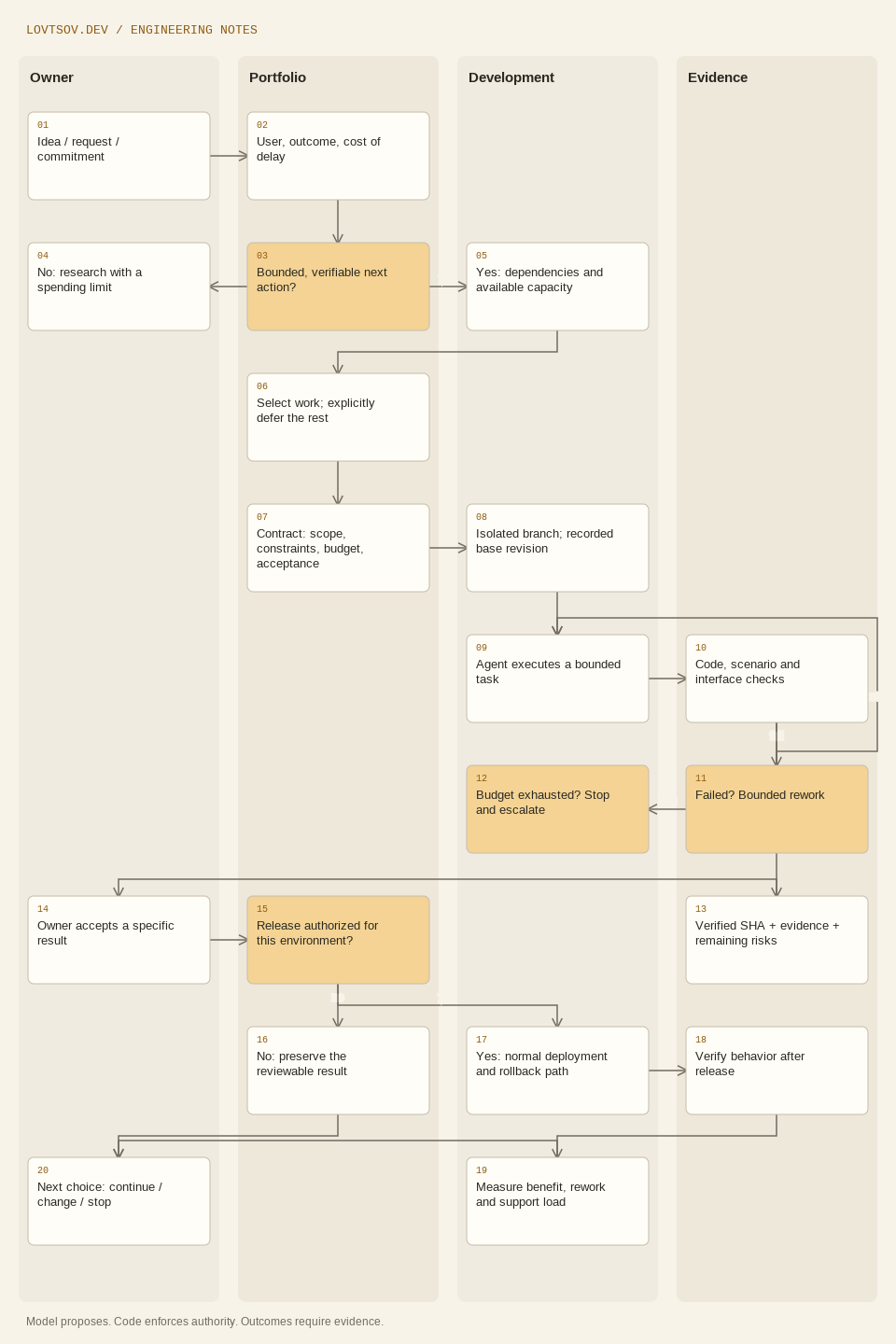
Restarting a tool should not mean restarting the thinking from zero. Decisions, queue state, attempts and reasons for stopping must survive. But an old description of state is not proof of current behavior: before a consequential action, inspect the actual repository, environment and constraints.
Engineering layer · autonomous development mechanics
I distinguish the control plane from the execution plane. The first owns objective, priority, budget, authority and status. The second performs bounded work in a restricted environment. That is an architectural explanation, not a request to create a microservice for every English noun.
A task needs a stable identity, base revision, change scope, dependencies and acceptance criteria. Its executor receives an isolated working copy. Parallelism is appropriate where it does not create hidden competition for the same files, state or external resource. Two agents fixing one form are not necessarily more productive than one. Sometimes they are merely a more expensive explanation of a Git conflict.
A checkpoint binds evidence to a result. If tests passed on commit X and code changed afterward, X remains the tested version. The new result needs the relevant checks again. “Exact SHA” is a useful implementation detail: we accept a particular revision, not the general mood of a branch.
After failure, establish state first. Did the external action occur? Are there uncommitted changes? Is the previous worker still running? Is the operation safe to repeat? Switching providers automatically inside a modified working copy may double uncertainty rather than recover work.
Set stopping rules in advance: exhausted budget, repeated failures without new information, missing authority, conflicting changes, or an unknown external outcome. Stopping with an explanation is a legitimate result. “Almost finished” forever is a poor status even for a person, and worse for an agent.
Current LAF work includes task context and queues, isolated execution, checkpoints and owner handoff. Product checks and pilot materials do not justify advertising a generally available SaaS with an SLA. A new user still needs environment adaptation, scoped access, a bounded pilot and evidence of usefulness. I can present my own work without converting every local PASS into an enterprise guarantee.
The most expensive queue may be at the manager’s desk
Suppose agents finish 24 changes while I can accept three properly each day. Even with no new arrivals, clearing the queue takes eight days. Accelerating generation at that point is unhelpful if it only creates more unreviewed work.
I therefore limit work in progress, not just the number of executors. Starting another task should account for the capacity to accept work already underway. A result should arrive with context and evidence, reducing switching cost and making the change itself easier to inspect.
Practice · acceptance, observability and economics
A result card should answer: which user scenario changed, where to inspect it, which checks completed, which revision they cover, what remains untested and what decision the owner needs to make. “Everything is ready; tests are green” without those details is an invitation to conduct an investigation.
| Metric | Why it matters | A poor substitute |
|---|---|---|
| Accepted useful changes | Measures completed outcomes | Commits or lines generated |
| Owner acceptance time | Reveals the actual bottleneck | Model runtime |
| Review queue age | Exposes accumulated debt | Number of active agents |
| Rework after acceptance | Tests the initial quality judgment | First successful test run |
| Cost per accepted task | Connects spending to value | Price of one model request |
| Explained stops | Makes the process improvable | Obtaining DONE at any cost |
A pilot needs a log of comparable tasks. Before execution, record the objective, constraints, manual baseline estimate and acceptance criteria. Afterward, record review, intervention, rework, model cost, outcome and regressions within an agreed observation window. Inflating the manual baseline would create fictional savings, so comparability and selection matter.
Illustrative economics: a task estimated at eight manual hours takes two hours of acceptance, one hour of intervention and one hour of subsequent correction. That leaves four hours of potentially released time before infrastructure and monetary costs. It does not mean four hours of salary immediately return to the company’s bank account. Time becomes value when it enables useful work or avoids a real additional expense.
Model, infrastructure and implementation costs still count. If the net result is negative, adding more agents is not a cure. Improve the specification, reduce task size, simplify the architecture or leave the action to a person.
Process observability must show failures too: stalled and unknown tasks, incomplete checks, checkpoint age and drift between source and running revision. If an agent reports completion while a mandatory check is still running, the task is not finished. An honest unfinished result is more useful than an elegant fictional completion.
A change I would accept
Here is an example of an acceptance record I can share without granting access to my projects. “Opened the source document, changed a deadline, saved it. After a restart the new date remained, and the previous edition was available in the history.” Attach the input, the expected change and the result of reopening the document. A screenshot of the new deadline alone goes back for rework: the screenshot will survive a restart beautifully, but we still know nothing about the document.
I write the skill myself for cases like this, specifying permitted actions and the difference between a finished job and an attractive demo. An agent can prepare the change and collect evidence. Whether that evidence is sufficient for this particular risk is my call. With ten projects that is why I am more interested in shrinking the acceptance queue than in adding another parallel worker.
Where a personal system meets an enterprise
For my own work I can change a process quickly and understand the cost of failure directly. A company has different departments, data ownership, support obligations, access lifecycles and customer commitments. Copying a script does not implement autonomous development across those boundaries.
The opposite extreme is familiar too: building an internal-specialist platform before deciding which useful task will run on it. I would verify one complete process under real constraints, then repeat it in a different team. Shared infrastructure should emerge from repeatability rather than an impressive block diagram.
Comparison · personal portfolio and enterprise
| Question | Personal products | Large organization |
|---|---|---|
| Who chooses work? | One portfolio owner | Agreed product and technical priorities |
| Who authorizes actions? | Explicit task boundaries | Roles, separation of duties and audit |
| Where is context? | Separate projects and decision history | Data classification and purpose-bound access |
| How is work verified? | Proportionate to change risk | Release policies plus domain criteria |
| Who accepts the outcome? | Owner, sometimes an external participant | Accountable customer and engineering owner |
| How is benefit measured? | My released time and useful output | Total cost, support, quality and failure consequences |
The transferable principles are bounded tasks, durable state, verified revisions, budgets and stopping on uncertainty. Corporate identity, data access, responsibility, operations and integration with an existing delivery process require deliberate design. A framework’s name does not exempt us from that work.
I would constrain a pilot to one kind of change, a small repository set and agreed actions. Compare similar tasks, including failures. Include human time and subsequent regressions in success criteria, not merely time to a pull request.
A platform becomes justified when costly work repeats: safe environment preparation, shared decision history, budget management and contract checks. Its team needs consumers, service ownership and an understood support cost. Otherwise we have simply added an eleventh project to the original ten. Technically solved; managerially more interesting.
What I would do over the next two weeks
Choose one outcome for a core product, one uncertainty-reducing experiment and a separate commitment to the book. Give each an acceptance criterion, a budget of human attention and a stopping rule. Explicitly defer the other projects while preserving their next possible step.
After week one, inspect what was actually accepted, what review cost and where the plan was imaginary. In week two, change the specification process as well as priorities. If an agent misunderstands a task three times, inspect more than the agent.
I still write code, test, examine architecture and use new tools. Increasingly, I value finishing a bounded useful piece of work. In a world where starting has become easy, that is becoming a competitive advantage.
If you have several products or a large team queue, begin with a real case: what stalls, who accepts the result and how much effort rework consumes. Contact me through the assistant. That is a useful starting point for Planograph or a demonstration of the LAF approach, without promising that another tool will automatically produce a third weekend day.
Vladimir Lovtsov, Director of Project Portfolio Management
Related Articles
Everyone is busy, nothing moves: planning with real constraints
Three developers are free on Tuesday. On Thursday I have one analyst for four hours. Two teams have already promised Friday releases to their customers. Assume everyone is telling the…
Requirements that survive an encounter with an agent
At 09:29 I notice the word “tomorrow” in an announcement about a meeting taking place today. I fix it and press Save. Meanwhile another perfectly sensible part of the program is watching…
An AI agent you can answer for: requirements, workflows and production boundaries
How I built a Telegram agent in a day: deterministic workflows, an optional LLM, approvals, APIs and delivery. Python and LangGraph examples, observability, tests and an enterprise comparison.