
Three developers are free on Tuesday. On Thursday I have one analyst for four hours. Two teams have already promised Friday releases to their customers. Assume everyone is telling the truth. As their manager I now owe someone a phone call. Which customer should I call, and what can I offer?
Planograph is my development planning tool. It breaks work down by role, shows dependencies and compares committed effort with available capacity. The interesting part starts when two reasonable promises compete for one real person. Here is a worked example with invented task names. You can check the arithmetic on paper.
Four hours available, six hours requested
Team A has added a filter to a report. Team B has built a reconciliation between two data extracts. Both changes are ready for verification by Wednesday. Checking the filter against a sample takes the analyst two hours. Investigating the differences between extracts takes four. Thursday’s window runs from 10 to 14. The next four hours are available on Monday. Releases can go out on Friday or the following Tuesday. The checks are independent, and an unchecked change cannot ship.
| Option | Thursday, 10–14 | Friday release | Monday | Following Tuesday |
|---|---|---|---|---|
| Keep both promises | Six hours of work in a four-hour window | Infeasible | — | — |
| Protect the filter | Two hours on A, two on B | Filter | Remaining two hours on B | Reconciliation |
| Protect reconciliation | Four hours on B | Reconciliation | Two hours on A | Filter |
In the first option the business waits longer for reconciliation. In the second it waits longer for the filter. Those delays need not cost the same. If staff reconcile the extracts manually before month-end, how many manual runs fall before Tuesday? If the filter was promised for a Friday demo, can the customer use the previous report, and which conclusion will they be unable to draw? The team best at narrating its suffering does not necessarily have the more urgent job.
One assumption matters. We can pause B for the weekend and resume on the same data. If the extracts refresh over the weekend and there is no snapshot, the first two hours may have to be repeated. The dates on the slide still say Friday and Tuesday. The effort has changed. This is why I keep the assumptions next to a scenario. A neat calendar is remarkably convincing once people forget what had to be true to make it work.
A result you can check in the planning engine
Planograph has a small reproducible test of an independent verification queue. One specialist has a completed two-day task and two open estimates of seven and three days. Everything else can be anonymised. The seven-day job stays in the first interval, the three-day job moves to the next, and the completed task retains its original record. The total was twelve person-days before the calculation and is twelve afterwards. Running the calculation again must leave the same result.
I like this check better than a perfectly filled Gantt chart. It catches three real management problems: disappearing effort, rewritten history, and a future that shifts every time someone clicks Recalculate. This is a controlled example. A team promising a real analyst’s time on Thursday still has to talk to the analyst.
What I would take to the meeting
I would bring both rows of the table, the analyst’s calendar and one question: which Friday promise would hurt more to break? Record an owner and a reason alongside the chosen option. If a two-hour slot opens on Wednesday, return to the six hours of demand and check whether the extract will be ready by then. Adding free hours to the weekly total is insufficient. They must fall after the input is ready and before the release window.
Keep the rejected option next to the one you picked. When an assumption changes, comparing them takes minutes. Trying to remember precisely what three people agreed three weeks ago is an expensive way of storing planning history.
Where did the other four days go?
I also checked a small capacity example where a manager can verify the result on their fingers. One person has nine days available. Product work takes five. Defects take one, another mandatory check takes one, and two days are reserved for other commitments. A report that displays only five occupied days invites someone to sell the remaining four to the business. Those days have already been sold.
The Planograph check returns five product days, four days of other commitments, nine used out of nine, and zero free. A manager can now release a specific reservation, find a qualified substitute or move the promise. The most expensive decision often looks like the cheapest one: write “we will find the capacity” in the minutes. The table still has zero days left.
Ask who can release a reservation and who takes the risk when they do. Without an owner, treat it as a hard constraint. With one, you have another feasible option, a named decision maker and a price.
What this means for the product
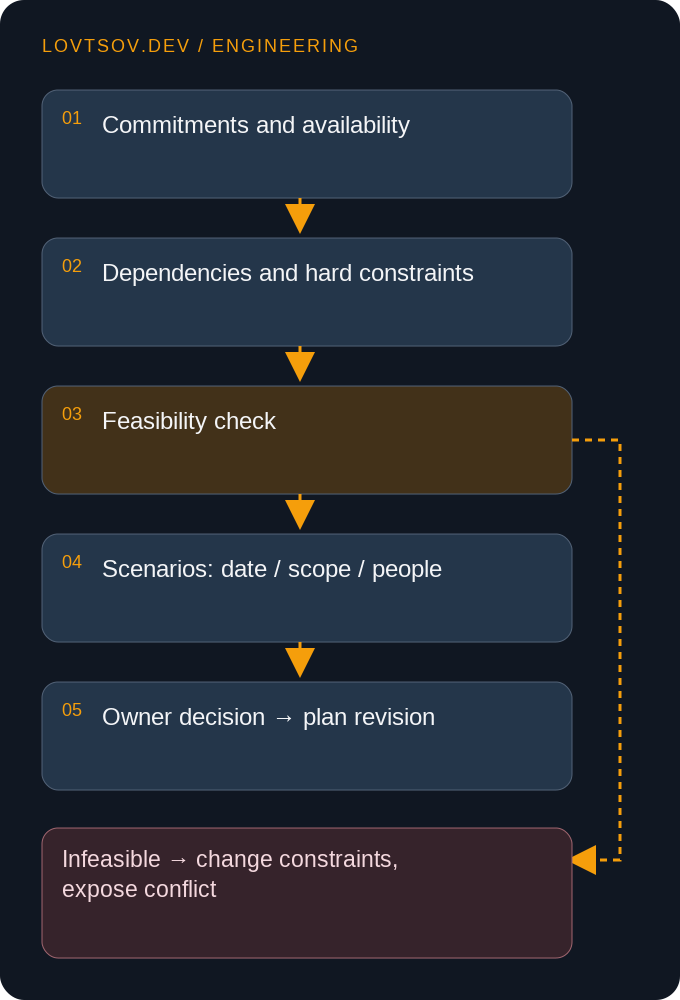
The person supplies commitments, availability and dependencies. The system first exposes contradictions: an unavailable specialist, unfinished prerequisite or deadline incompatible with remaining capacity. It then proposes alternatives: change the date, reduce scope, reorder work or add a specific capability. “Add resources” without identifying which resources is an appeal to the universe, not a plan.
Each option needs an outcome and a price: delayed work, additional risk, owner attention and changed assumptions. The baseline remains available for comparison. An accepted scenario receives a revision and an accountable owner. A model can explain differences; it must not silently relax a hard commitment to produce an attractive answer.
Verification starts with small independently checkable cases, then introduces calendar conflicts, dependency cycles and infeasibility. The last outcome matters particularly. A good product can say, “These conditions cannot all be met.” A bad one draws green bars.
Planograph is one of the products I am preparing for a clearer external presentation. If the loudest request repeatedly wins in your portfolio, a useful discussion starts with one real resource conflict. That case reveals value more effectively than a showcase of a hundred features.
Vladimir Lovtsov, Director of Project Portfolio Management
Related Articles
Requirements that survive an encounter with an agent
At 09:29 I notice the word “tomorrow” in an announcement about a meeting taking place today. I fix it and press Save. Meanwhile another perfectly sensible part of the program is watching…
10+ projects and one weekend: my autonomous development framework
I have more than ten personal projects. I also have a job, a family, two children and a persistent suspicion that the next calendar update will not include a third weekend day.
An AI agent you can answer for: requirements, workflows and production boundaries
How I built a Telegram agent in a day: deterministic workflows, an optional LLM, approvals, APIs and delivery. Python and LangGraph examples, observability, tests and an enterprise comparison.