
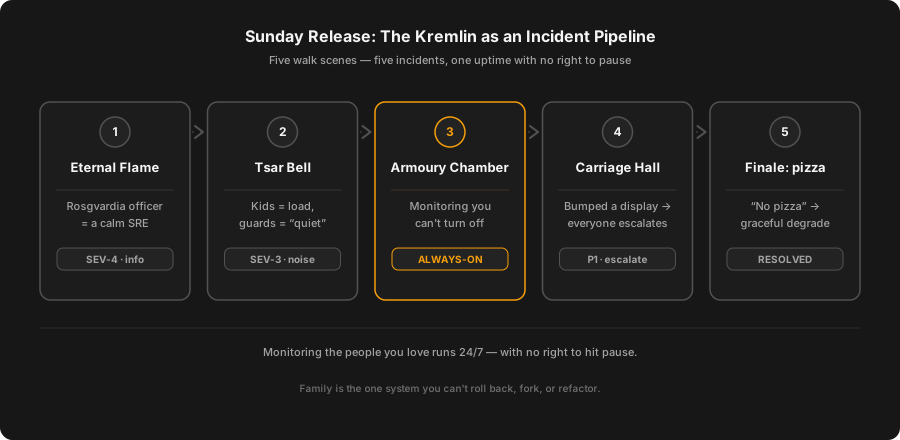
One Sunday, my family and I went for a walk in central Moscow. After a long stretch of remote work, I discovered that my engineering vocabulary had followed me outside: an ordinary day quickly filled up with alerts, load tests, and possible failure points.
The idea came from my wife:
“Let’s go for a walk in central Moscow.”
Command accepted. The family release was under way.
Months at home can narrow life into a loop of calls and tasks. Even after leaving the laptop behind, the mind keeps looking for metrics and incidents. The habit does not disappear on a walk, but it becomes easier to laugh at.
Scene one. The Tomb of the Unknown Soldier
My youngest decided to test the chain around the memorial. An officer came over and calmly asked him to stop, with no raised voice or unnecessary fuss. It was a small but useful example of how to enforce a rule without turning the situation into a conflict.
Scene two. The Tsar Bell
At the Tsar Bell, the children ran a brief load test on the acoustics. One shouted, the other joined in, and a guard interrupted the experiment:
“Quiet within the walls of the Kremlin.”
Fair enough. Federal monuments are not a staging environment. The children accepted the constraint and moved on to the next experiment.
Scene three. The Armoury Chamber
In the Armoury Chamber, my eldest reached toward the Fabergé eggs to check whether they were real. Security responded immediately. So did my internal monitoring.
My youngest watched all this and whispered:
“Dad, is that monitoring?”
“Yes, son. Only with no right to switch it off.”
It was an accurate description. A work alert can be silenced or handed to the person on call. Attention to children and the people close to you stays on.
Scene four. The Hall of Carriages
In the carriage hall, my wife was telling the children about Russian history and accidentally brushed a display case. This time the attendant’s attention moved from the children to the adults. He was alert but not harsh. Staying calm while enforcing rules in a steady stream of visitors is a professional skill in its own right.
Scene five. Wrapping up the release
By the end of the walk, everyone had one clear KPI: find some pizza. The restaurant had none. We adjusted the plan, and lasagna with dessert proved to be a perfectly good fallback. Incident closed; no postmortem needed.
Moscow as production
Over coffee, I looked at the two tired “microservices” across the table and at my wife, who keeps our family architecture together. That day Moscow did feel a little like production: noisy, unpredictable, and alive. Sometimes it returns “no pizza,” but it usually leaves room for a fallback route.
The work metaphors never went away, and that was fine. For one Sunday, they helped me notice the people beside me and spend a few hours outside the familiar home-office loop.
Originally published on my Telegram channel @it_underside.
Yours, DPUPP
Related Articles
Tech Lead: A New Challenge for an Analyst
Moving from analyst to project IT lead: building a team, establishing delivery practices, and discussing constraints with the business.
Hiring Signals from a Manager’s Perspective
Behavioural patterns, an interview radar and the manager’s own blind spots: assess working risks without pretending to diagnose a personality.
The Shoemaker’s Own Shoes: Rebuilding My CV
How I removed technical noise from an executive CV, made the career trajectory visible, and established a clear CTO direction.