Analysts and Their Many Flavors
Who an analyst actually is in IT and what specializations exist: a tour of 18 kinds of analyst — from business and systems to Data Scientist — plus salary ranges and why the field has real upside.
Intro
IT changes faster than anyone can print the job descriptions. Somewhere in that current sit the analysts — the people who turn the business's "I want it to work" into requirements development can actually build against. If you're weighing a career in analytics, the first question is simple: who even are these people, and what kinds are there?
Let's break it down. One caveat up front: the list below is not gospel. There are roughly as many classifications as there are analysts, and every one of them will argue their version until they're hoarse.
What is an analyst?
An analyst (from the English analyst) in the broad sense is a specialist who takes data, processes, and events apart to find patterns in them, and on that basis formulates conclusions and recommendations. Such people are needed everywhere: economics, finance, medicine, marketing, sociology.
An analyst in IT does the same thing, but applied to information systems: they analyze the processes, data, and requirements around development. They work at the intersection of business and technology — helping the client figure out what they actually want from the system, and helping the team design and build it so that it solves a business problem rather than merely compiling.
There are a lot of specializations: business analysts, systems analysts, data analysts, and another dozen flavors. Each has its own tasks and area of responsibility. Those are what we'll talk about.
Kinds and sub-kinds of analysts
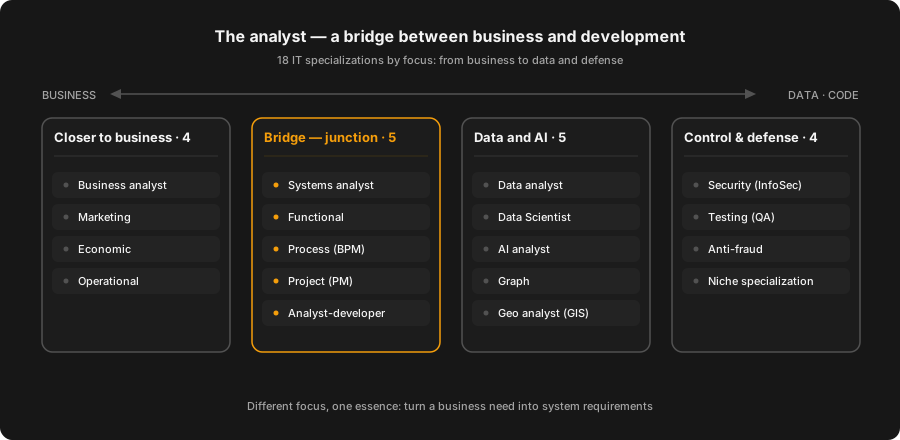
Here's the list. You can argue about it forever — everyone has their own opinion — but all of these roles genuinely exist and are genuinely being hired for in companies right now:
- Business Analyst;
- Systems Analyst;
- Data Analyst;
- Security Analyst;
- Functional Analyst;
- Business Process Analyst;
- Quality Assurance Analyst;
- Project Management Analyst;
- Marketing Analyst;
- Geospatial Analyst;
- AI Analyst;
- Graph Analyst;
- Anti-Fraud Analyst;
- Economic Analyst;
- Operations Analyst;
- Specialized Analyst;
- Data Scientist;
- Developer Analyst.
Now let's take each in turn.
1. Business Analyst
Works at the intersection of business and technology. Digs through business processes, pulls the client's real needs and requirements out into the open, and proposes what to improve and how. Essentially, they translate from the language of business into a language the development team will understand.
2. Systems Analyst
Digs deeper — into the system itself. Gathers requirements and turns them into specifications used to build a new product or rework an existing one. Keeps the line open between the client, the programmers, and the rest of the team so that the system ends up doing exactly what the business needs.
3. Data Analyst
Collects, processes, and interprets data so the business makes decisions on numbers rather than by eyeballing it. Hunts for trends and patterns, builds reports and visualizations, and works with large datasets and the tooling that comes with them.
4. Security Analyst
Protects systems and data from threats and attacks. Looks for vulnerabilities, builds a defense strategy, monitors what's happening on the network, and is first to respond to incidents. The job is to make sure leaks and breaches don't happen — and if they do, that you don't find out about them from the news.
5. Business Process Analyst
Specializes in getting the manual grind out of processes. Studies how the work is set up today, finds the bottlenecks, and decides what can be handed off to a system. From there come recommendations on rolling out BPM systems, configuring workflows, and integrating applications with one another.
6. Quality Assurance Analyst
Owns product quality. Writes test cases, runs functional and integration testing, and catches defects before the user does. The goal is software that runs stably and predictably.
7. Project Management Analyst
Plans and runs IT projects: draws up the plan, lays out the resources, and keeps an eye on tasks, deadlines, and budget. In large part it's this person who determines whether a project reaches the finish line or gets stuck halfway.
8. Marketing Analyst
Works with marketing data so decisions aren't made on gut feeling. Studies customer needs, sizes up competitors, measures the effectiveness of ad campaigns, and uses the numbers to help build strategy.
9. Geospatial Analyst
Works with geography: maps, GIS, location data. Analyzes spatial data and builds maps for geology, geodesy, transport — anywhere it matters not just "what" but "where."
10. AI Analyst
Specializes in data and machine-learning models. Works with large datasets, finds patterns, and creates and trains AI systems. Helps companies automate processes and build products on top of artificial intelligence.
11. Security Analyst
Handles the organization's information security: analyzes vulnerabilities, builds up data protection, monitors events, and responds to incidents. The playing field is cybersecurity — protecting networks and applications.
12. Graph Analyst
Analyzes and visualizes data structured as a network of connections: social graphs, transport networks, graph databases. Finds hidden patterns and links where a plain table is powerless.
13. Anti-Fraud Analyst
Catches fraudsters. Analyzes transactions, builds algorithms that flag suspicious operations, and shields the company's and its customers' money from financial fraud.
14. Economic Analyst
Analyzes macro- and microeconomics: studies markets and trends, gauges the overall climate, and builds forecasts. The output is the economic foundation a company leans on when making decisions.
15. Operations Analyst
Optimizes a company's operations. Takes work processes apart, finds where time and money leak out, and proposes how to fix it and cut costs.
16. Specialized Analyst
Tuned to a specific niche: customer data, the securities market, manufacturing processes — whatever it is. Uses methods and tools specific to their domain that simply wouldn't be needed anywhere else.
17. Data Scientist
A specialist who performs complex data analysis using statistics and machine learning. Extracts valuable insights and predictions from large datasets that the business builds decisions on. Of everyone on the list, this one is closest to science.
18. Developer Analyst
A hybrid: combines systems analysis with development. Gathers the requirements themselves, designs the technical solution themselves, and writes it themselves too. A rare beast, but a valuable one.
A word on salaries
Average monthly salary of systems analysts in Russia in 2022, per data from habr.com and Yandex Praktikum:
- Junior systems analyst: 58,000 — 100,000 rubles;
- Middle systems analyst: 100,000 — 175,000 rubles;
- Senior systems analyst: 175,000 — 306,000 rubles.
Over 2023 the numbers grew by roughly 10% on average. And for strong expertise, top IT companies are willing to pay a Senior analyst upward of 400 thousand.
Is it worth getting into
Analytics in IT is a living, promising field. Here are a few reasons to take a serious look at it.
1. A variety of specializations
There's a truckload of analyst types, and each has its own tasks. You can pick the one that clicks for you specifically: business analysis, data, information security, or something more niche.
2. High demand for specialists
Analysts are in active demand. The faster companies go digital, the more they need people who can put order into requirements and data. A serious project rarely kicks off these days without an analyst.
3. Analytical skills
The profession builds up critical thinking, the ability to work with data, and decision-making. That pays off beyond work too — the habit of sorting chaos onto shelves stays with you everywhere.
4. Decent pay
The pay is good, especially at Middle and Senior. Analytics is one of those IT specializations where the money catches up to the expertise.
5. Room to grow and develop
There's somewhere to grow. The path from Junior to Middle to Senior is clear, and beyond that it's either deep expertise in your niche or a move into adjacent roles.
Knowing what kinds of analysts exist is useful if only so you can pick your specialization deliberately rather than by pointing at the sky. And whatever you end up choosing — an analytical mind will never go out of style in IT.
Originally published on my Telegram channel @it_underside.
Yours, DPUPP
Related Articles
Analysts and Their Many Flavors
Who an analyst actually is in IT and what specializations exist: a tour of 18 kinds of analyst — from business and systems to Data Scientist — plus salary ranges and why the field has real upside.
Cooperative vs Employment: A Conversation the Community Was Ready to Have
Notes from conversations with RAD-KOP, a Russian cooperative IT community. Not 'here's my pitch' but 'here's where the dialogue took us': a comparison of models, real-world examples, and an honest look at the downsides.
The Value We Create — and Almost Never Keep for Ourselves
In IT we create value every single day: we fix prod, cut risk, clear out the chaos. Yet almost none of us actually owns the result. A look at an uncomfortable paradox — without the drama.