Does a Software Engineer Need a Degree If Everything Is Already Online
People call a diploma a fancy coaster: take a couple of courses, learn a language, and you have conquered the peaks. Here is why a solid academic foundation still wins — systems thinking, math, and the skill of digging up knowledge where no guide has been written yet.
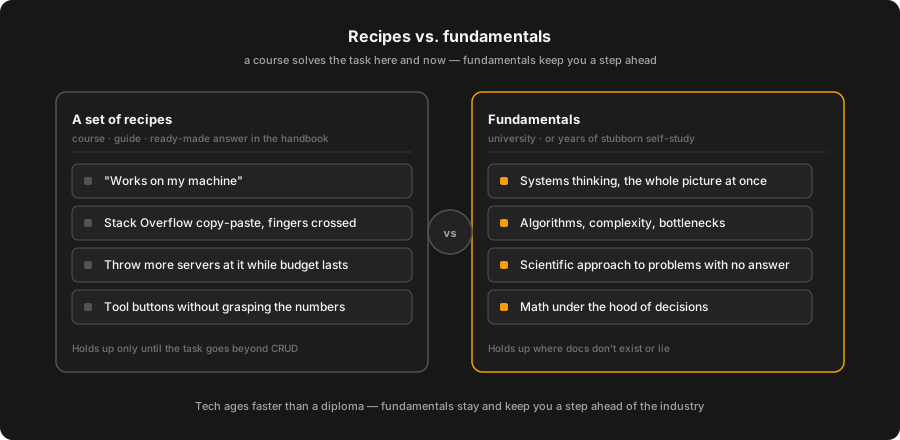
Every now and then the eternal debate flares up in the comments: does a software engineer need a degree, or is it just an expensive coaster for your mug? Since we recently ran this very topic in a poll, let me lay it all out — why I still come down on the side of fundamentals. Not because "that's how it's done," but because I see the difference in practice.
The diploma as a coaster
The argument goes like this: pick up a couple of programming languages, take a two-month course, and you're ready to conquer the world. A diploma is a formality, a piece of paper that's the first thing you lose when you move. And there's some truth to it: a framed diploma on its own has never made anyone a strong engineer. I know people without a degree who could run circles around half the graduates of the relevant departments.
But let's be honest: this argument usually gets trotted out to justify not wanting to dig into the boring stuff. "I don't need calculus, I just crank out forms" — sound familiar? The problem is that a career doesn't end at forms. And when a task steps outside the bounds of yet another CRUD app, you can suddenly tell who has a foundation under the hood and who just has a set of memorized recipes.
This isn't about the certificate. It's about what should be standing behind it. And that's where things get interesting.
Depth of thinking and systems vision
University gives you not so much knowledge about specific technologies — those will be obsolete before you graduate — as an understanding of how systems are built in the first place. Architecture, design patterns, scaling — all of it comes through the core disciplines and the big student projects where you first hit the wall of "works on my machine" not being an argument.
Take analytics. It's not just about gathering requirements and drawing a couple of charts. It's about breaking down business processes, understanding cause and effect, being able to formulate a hypothesis and test it instead of just believing it because "well, it's obvious." Higher education teaches you to look at a system as a whole: not at isolated data points, but at the complete picture where everything is connected to everything else. No three-month bootcamp will teach you that skill — there simply isn't enough time for your thinking to actually get rewired.
A foundation for hard problems
Reliable software requires an understanding of algorithms, data structures, and optimizations. Courses on algorithms, computation theory, operating systems, and even plain old calculus are the foundation for solving non-standard problems. The ones that don't get googled on the first try.
A real-world example: when a system starts choking under load, a person with a foundation thinks about algorithmic complexity, about caches, about where the memory bottleneck is. A person without one usually does one of two things — either throws more servers at it (as long as the budget holds) or copies the first Stack Overflow answer with a green checkmark and hopes it flies. Sometimes it flies. And sometimes it holds up right until the first real traffic.
For analysts it's the same story: building forecasting models, optimizing processes, running A/B tests — all of it rests on statistics, probability theory, and econometrics. You can poke buttons in an off-the-shelf tool and get numbers out. Or you can understand what those numbers mean, where the p-value is lying to you, and why your sample isn't representative. The difference between those two people shows up in salary and in who gets trusted to make decisions. Though to actually get that foundation, you have to genuinely study, not warm the back-row bench — university doesn't level up your brain on its own, it only provides the environment.
How to dig up knowledge when no guide exists yet
This, in my view, is the most underrated part. When the standard methods don't work and the task goes beyond the familiar, the scientific approach takes the stage. And that's exactly what a proper higher education teaches you:
- to frame a problem in a way that can actually be solved methodically, rather than "let's just try something";
- to conduct research: find sources, evaluate them critically, tell a paper backed by data apart from a blog post written in a confident tone;
- to gather knowledge from different fields and stitch it into a solution that didn't exist before you.
A course teaches you to solve problems that already have a ready answer in the manual. University — ideally — teaches you to approach problems that have no answer yet. In an industry where you regularly find yourself on the frontier, where the documentation is either missing or lying, that skill is worth its weight in gold.
Math isn't about grades, it's about tools
Understanding algorithmic complexity, working with parallel computing, cryptography — you've got nothing to do here without a mathematical foundation. This isn't abstract theory for the sake of a checkbox in your transcript; these are working tools for building efficient and secure systems.
For analysts — mathematical statistics, optimization methods, game theory. These are precisely what let you build models that actually work and make the business money, rather than just looking pretty on a slide. When you understand the math under the hood, you see the problem more broadly: not a single "make it good" button, but a space of options and their cost.
Yes, 90% of the time you won't be using that math. But the remaining 10% are exactly the moments when the genuinely hard things get decided, and when you get set apart from those who "know their way around a framework."
An engineering mindset
Higher education shapes a particular way of thinking. A drive for optimization, reliability, and scalability. The habit of anticipating a problem and putting it out at the design stage, instead of at three in the morning on prod. The ability to spot hidden dependencies, to dig down to the root causes rather than treating symptoms.
This isn't to say a person without a degree can't do that. They can — if they've deliberately built that discipline of thinking in themselves, over years, on their own. It's just that university delivers it in concentrated form and under the supervision of people who have already walked that road. The self-taught have to invent the route from scratch, and that takes longer and comes with more bruises.
So do you need a degree or not
My conclusion: higher education isn't a diploma on the shelf, it's a deep understanding of principles and approaches that let you solve hard problems and see a solution where many others see a dead end. It's the ability to think systemically, evaluate information critically, and keep teaching yourself.
Technologies change fast, and the only thing that gives you a foothold here is a foundation: with it, you're not chasing the industry, you're a step ahead of it. No course gives you that base — it gives you a skill for a specific task here and now. The base comes from university (or from several years of stubborn self-education — which, in terms of effort, is honestly the same university, just without a timetable).
So if you're in university right now and thinking calculus is a waste — don't be so quick. And if you don't have a degree and never will — don't sweat it, but don't kid yourself either: you'll still have to lay the foundation, just with your own hands. The coaster has nothing to do with it.
Originally published on my Telegram channel @it_underside.
Yours, DPUPP
Related Articles
Cooperative vs Employment: A Conversation the Community Was Ready to Have
Notes from conversations with RAD-KOP, a Russian cooperative IT community. Not 'here's my pitch' but 'here's where the dialogue took us': a comparison of models, real-world examples, and an honest look at the downsides.
The Value We Create — and Almost Never Keep for Ourselves
In IT we create value every single day: we fix prod, cut risk, clear out the chaos. Yet almost none of us actually owns the result. A look at an uncomfortable paradox — without the drama.
Red Flags in Hiring, Through a Lead's Eyes
Behavioral patterns in candidates I've learned to spot over years of hiring. Not an HR checklist, but the view of a manager who builds teams.