Word of the Day — Idempotency
A quick primer on idempotency: what this property of operations is, why it matters for system reliability, and where it shows up — from HTTP methods to databases and blockchain.
Morning! How often do you run into this term? My guess is not much — outside of college, anyway). But when we caught a bug in Tarantool's basic CRUD module, idempotency came up more than once: for every operation we had to prove whether it was idempotent or not. Here's a short primer — hope it comes in handy.
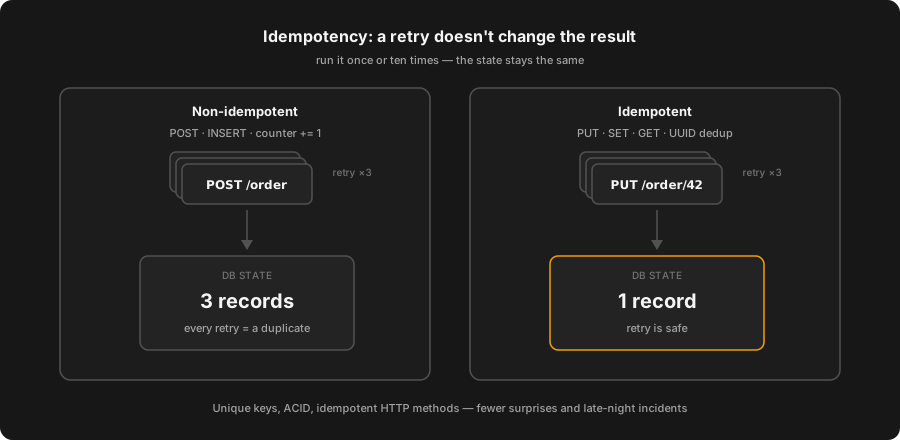
Idempotency is a property of an operation where calling it again doesn't change the object's state compared to the first call. Run it once, run it ten times — same result. Sounds academic, but this is exactly what reliability and safety rest on across a lot of IT.
Origin and use
The term came from mathematics and took root in IT: programming, system administration, testing, data analysis — each has its own use for it.
Use for SAs, testers, developers, and DevOps
- SA — when designing systems, especially distributed ones, where several operations hit the same data.
- Tester — to make sure a rerun doesn't spring surprises: is it a bug or a feature))
- Developer — for data integrity: so a retry doesn't break state.
- DevOps — so a re-run of a playbook doesn't spawn extra changes (this is what all of Ansible stands on).
And so on — I won't ramble, I did promise a short piece.
Use in databases
In relational databases it's enforced by unique keys and ACID transactions. In NoSQL and caches like Redis — by commands that yield the same result on a repeated write: the same SET overwrites the value instead of multiplying duplicates.
Examples of technical implementations
- Web services lean on idempotent HTTP methods: GET and PUT return one result no matter how many times you repeat the request.
- In distributed systems, a unique request identifier (say, a UUID) helps process it exactly once — even if the client fired it off five times in a row.
- In blockchain, the immutability of blocks is a kind of idempotency too: once data is added to the chain, it doesn't change anymore.
Takeaway
Idempotency is the foundation of reliable systems. It guarantees that repeating an operation won't break anything and that state stays predictable. That's why it's loved everywhere — from development to administration: fewer surprises, fewer late-night incidents.
Originally published on my Telegram channel @it_underside.
Yours, DPUPP
Related Articles
Event Storming Without the Hype: Pros, Cons, and a Sticky Note on Your Forehead
A personal take on Event Storming after more than one "event storm": where it genuinely saves a team, where it turns into pointless sticker-therapy, and what it takes to keep a session from going down the drain.
Data Exchange Formats: From JSON to Protobuf
A deep dive into data exchange formats: where JSON lives, why XML still matters, what makes YAML great, and when it is time to switch to binary Protobuf, Avro, and MessagePack — tied to APIs and message brokers.
UML: what kind of beast is it, and why analysts steer clear
UML can visualize, specify and document a system — yet you almost never see it used on real teams. Let’s figure out what it’s for, why analysts avoid it, and where it actually pays off.