Event Storming Without the Hype: Pros, Cons, and a Sticky Note on Your Forehead
A personal take on Event Storming after more than one "event storm": where it genuinely saves a team, where it turns into pointless sticker-therapy, and what it takes to keep a session from going down the drain.
When you show up to a team with the idea "let's run an Event Storming session," the reaction always splits in two. Some people happily grab their stickies and markers; others tap their temple in the classic "here we go with the rituals again" gesture. And here's the honest question: is your team really so switched-on that everyone actually knows why this thing matters? I've got more than one "event storm" under my belt, so let's be straight with each other — we'll break down what's good about it and what isn't.
What Event Storming is in 30 seconds
The short version: it's a workshop where the team lays out, on a big board (physical or virtual), the events that happen in the system — in chronological order, on sticky notes. "Order created," "Payment went through," "Item reserved," "Notification sent." Different colors mark commands, aggregates, external systems, pain points. And out of this mosaic, something suddenly emerges that used to live only in a few people's heads and never overlapped anywhere.
Sounds lovely: everyone got together, talked it through, shared their thoughts, found some insights. In practice, any format like this is a quest in its own right — especially when people's eyes are a mix of exhaustion and a wish to "just not touch anything anymore." So let's go point by point, no rose-tinted glasses.
What's genuinely good
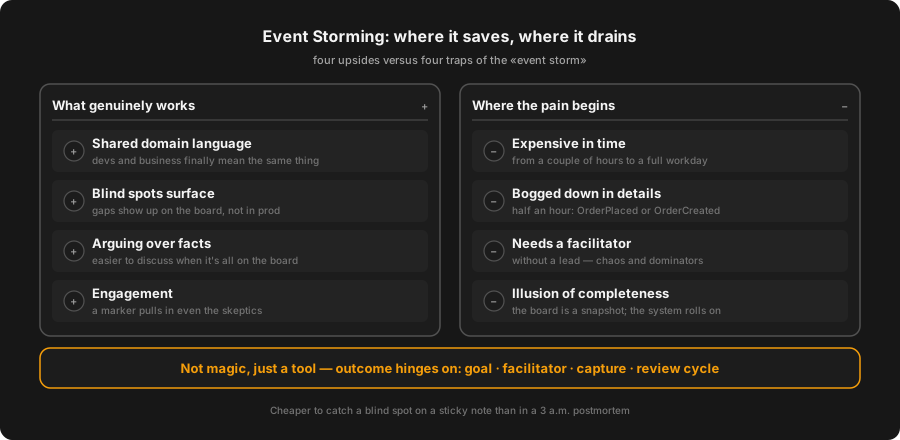
1. Shared understanding of the domain. This is the main prize. Everyone — from the developer to the business analyst — finally starts speaking the same language. When events are visible, insights come even to the people who "kept quiet" up to now. The very colleagues who usually stay in the shadows, but who you suddenly remember when the "so who actually designed this?" investigations begin. On the board they get a voice — and often it's exactly them who highlight the thing everyone else considered obvious and therefore never once said out loud.
2. Surfacing gaps and conflicts. "So what happens after the payment goes through?" — "Uh, no idea…" That dialogue is far better surfaced in a meeting with markers in hand than in production at three in the morning. Event Storming ruthlessly drags out the blank spots: branches nobody thought through, states the system can formally end up in, but what to do about them is an open question. It's cheaper to find this on a sticky note than in a postmortem.
3. It speeds up team collaboration. You end up with a shared board that holds a "picture of the world" — and discussing the tricky spots gets easier. People argue more willingly when everything is right there in plain sight, rather than when everyone holds their own version of the system in their head and is convinced theirs is the right one. An argument at the board is an argument about facts. An argument without a board is an argument about who misunderstood whom.
4. Higher engagement. Simple psychology at work here. People who love paper are thrilled they get to slap stickies up and move them around the wall. People who hate paper suddenly notice that the idea "goes digital" through the board faster than through hour-long calls and threads. The physical act pulls in even the skeptics: it's hard to stay on the sidelines when there's a marker in your hand.
Where the pain begins
1. Time cost. An "event storm" can take a couple of hours, or it can eat an entire working day. And some developers — introverts especially — would honestly rather spend that time on real code than on shuffling paper around. That's fine. Just plan for the fact that the session is an investment, and it has to pay off in problems found, not in a checkbox that says "did Event Storming."
2. The risk of drowning in details. If the facilitator doesn't "cut off" pointless branches, the session turns into an endless debate about how to properly name an event — OrderPlaced or OrderCreated. Half an hour arguing over naming, and everyone's forgotten why they gathered in the first place. You have to hold the level of abstraction deliberately: the big picture first, then a deep dive into the risky areas, not the other way around.
3. You need a competent facilitator. Without an active lead you'll easily end up with chaos. Someone will "steer" the discussion toward themselves; someone else will quietly hide behind everyone's backs and spend two hours on their phone. A good facilitator isn't the one who talks the most — it's the one who watches the pace, draws out the quiet ones, tamps down the dominators, and keeps focus on the goal. Without that role, the session fails no matter how great your team is.
4. The illusion of completeness. Even if you've beautifully mapped everything out on the board — it's only a "snapshot" of the situation on one particular day. The system lives on, requirements change, and yesterday's pretty picture may be lying to you a quarter later. The model needs revisiting, not treating as "done, we've studied the events forever." The most dangerous trap is when the team thinks the board is the source of truth, while the actual source of truth pulled ahead long ago.
How not to blow the session
If you gather the observations into a short checklist, here's what separates a working Event Storming from expensive sticker-therapy.
First, agree on the goal in advance. "Work through the payment flow" and "draw the whole system" are two completely different sessions in scale and depth. Without an explicit goal, you're guaranteed to sprawl all over the place.
Second, appoint a facilitator and give them the right to cut discussions short. This isn't a dictatorship, it's time management: the session has a time budget, and someone has to defend it.
Third, capture the result immediately. A photo of the board, an export from the virtual board, a list of the gaps found with owners assigned — otherwise a week later all that's left of the insights is a vague memory of "we found something important, I think."
And fourth, build in a revision cycle. The model is alive. If you don't come back to it, it'll go stale at exactly the rate the system changes.
Bottom line
Event Storming is a powerful tool that rallies people around a shared understanding of the system. But it's not magic that solves every problem with a couple of hours of sticky-note fiddling. You need a person capable of steering the discussion, and a willingness to keep the model current afterward. But if you go about it smartly, you'll dodge sudden "blank spots" in the logic and noticeably improve how the team works together. And that, trust me, pays off faster than it seems going in.
P.S. If, after the session, someone sticks a PaymentFailed note on their forehead — that's fine. The main thing is that they understand how that event leads to PaymentRetried and PaymentSucceeded.
Originally published on my Telegram channel @it_underside.
Yours, DPUPP
Related Articles
Event Storming Without the Hype: Pros, Cons, and a Sticky Note on Your Forehead
A personal take on Event Storming after more than one "event storm": where it genuinely saves a team, where it turns into pointless sticker-therapy, and what it takes to keep a session from going down the drain.
Data Exchange Formats: From JSON to Protobuf
A deep dive into data exchange formats: where JSON lives, why XML still matters, what makes YAML great, and when it is time to switch to binary Protobuf, Avro, and MessagePack — tied to APIs and message brokers.
UML: what kind of beast is it, and why analysts steer clear
UML can visualize, specify and document a system — yet you almost never see it used on real teams. Let’s figure out what it’s for, why analysts avoid it, and where it actually pays off.