The More Detailed the Spec, the Weaker the Developers — A Paradox I Keep Seeing on Projects
Why overly detailed requirements erode developer expertise over time, where the real pros and cons of a high-level spec lie, and how to strike a balance between predictability and team growth.
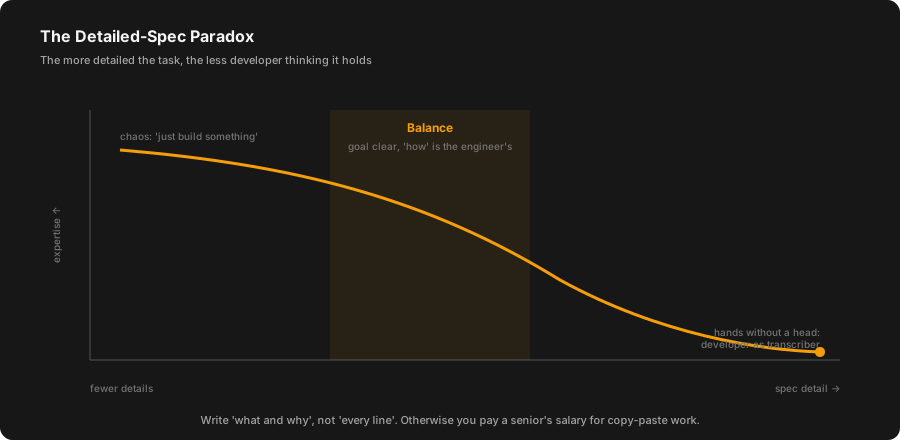
There's a paradox I've been watching play out on projects for years now: the more meticulously systems analysts write out the requirements, the weaker the developers on the team tend to be, on average. It sounds counterintuitive — you'd think a good spec could only help. Let's unpack why, in practice, it often turns out the other way around.
The paradox that started it all
The thought first hit me during an ordinary evening chat with a good analyst. We got to talking about how work is set up across different projects, and a pattern surfaced that I later started noticing almost everywhere.
Look. When analysts spell everything out down to the classes, functions, and specific methods, all that's left for the developer is to transcribe it into code. And the longer someone works in that mode, the faster their expertise rusts over. Or — the sadder version — their level was low to begin with, and the detailed spec just papers over it.
And the reverse: if the spec stays at the level of abstraction (describing containers and components rather than individual functions, roughly speaking), the developers on that project usually turn out to be a cut above. They have room to move: they make architectural decisions themselves, weigh the options — and they grow faster.
But, as usual, the coin has a flip side. The absence of detailed requirements is a risk. A developer can wander off course, and the sprint is gone. So don't rush to toss every spec in the trash — first let's honestly tally up the pros and cons of each approach.
Why a detailed spec drains expertise
Let's break down point by point what happens to a team when every decision has already been made for them.
No room for R&D. The analysts have "baked in" the whole solution; the developer just has to render it in code. Less creativity means fewer reasons to think about new technologies, algorithms, and patterns. And a muscle you don't train atrophies.
Shrinking initiative. When everything is thought through in advance, the developer turns into an executor — a coder, essentially. Over time this kills the motivation to propose alternatives and learn new things. For a strong engineer that's a road to nowhere: they either degrade or leave for a place where they're allowed to think.
The analysis bottleneck. Development waits for the analysts to finish their work. The document is stuck or sent back for rework — and the team sits idle. And by the time it finally reaches code, it's too late to change anything fundamentally: everything is tied to the approved requirements, and any edit drags a re-approval along with it.
The upsides of a detailed spec (they exist)
It would be dishonest to say a detailed spec is pure evil. It has very real upsides — the ones that make managers and clients love it.
- Predictability. The client and management understand the timelines and scope of work. For the business, that's often more important than the team's growth in expertise — and that's fine.
- A fast start. Easier to get going, fewer questions upfront. The developer opens the ticket — and it's immediately clear what to do, no need to spend a week figuring out context.
- Less risk on business logic. Analysts account for the nuances and scenarios a developer simply wouldn't dig up. Remember the broken-telephone meme? The client imagined one thing, the analyst understood a second, the developer built a third — and out comes something formally close but not it at all. A detailed spec narrows that gap.
And the downsides are exactly what we started with: the developer's growth hits a ceiling (a coder stays a coder), the team becomes dependent on the analysts (one inaccuracy of theirs propagates as a bug down the whole chain), and it loses the strong solutions people had, which stay unused. And being unused is a short road to burnout.
The flip side: a high-level spec
If you swing the pendulum the other way and leave only general requirements, you get the mirror image.
Upsides: flexibility, room for technical creativity, growth in expertise, solving problems together. The team feels like the authors of the product rather than operators on an assembly line — and that, by the way, is a currency of its own in the job market.
Downsides: a higher risk that things go sideways on timelines, scope, and quality. And — this is the crux — this approach needs a strong team that can take a punch. A weak one, without detailed requirements, just gets stuck in endless clarifications and drowns in "but how's it supposed to work?"
That's exactly why there's no universal answer of "detail it / don't detail it." Everything depends on the variables in the equation: what kind of company it is, how bureaucratic it is, how complex the project is, and who's on your team.
How to find the balance
There's no universal formula, and anyone selling you one is being a little disingenuous. But over years of working with different teams, I've built up a working checklist. It's subjective, the variables will need tuning to your situation — but as a starting point it holds up fine.
-
Split the zones of responsibility. Analysts own the business logic, user scenarios, and requirements. Lead developers own the architecture and technology choices. You don't want the analyst designing classes while the architect retells business processes.
-
Run joint workshops. Bring developers in during the requirements discussion, and analysts in on the review of architectural concepts. When both sides marinate in a shared context, the overall level of the team rises on its own.
-
Invest in motivation and culture. Create conditions where a developer is actually interested in proposing and justifying new solutions. If initiative doesn't get your hand slapped, you get more of it — banal, but it works.
-
Set flexible boundaries. Spell out in detail only the riskiest parts of the system — the ones where a mistake is expensive. Hand everything else to the team to work out. Let them think where they can think without the risk of taking down prod.
The takeaway
A detailed spec isn't good or evil, it's a tool with a side effect. It buys predictability at the cost of the team's growth. A high-level spec buys growth at the cost of risk. And the whole management skill here is understanding which one you need more right now, and where to draw the line between "spell it out down to the last function" and "figure it out yourselves."
If you've got a team of strong engineers and you're smothering them with detailed requirements — you're turning them into coders with your own hands and setting yourself up for a wave of burnout. If the team is weak and the spec is high-level — get a spare sprint ready, you're going to need it. The truth, as always, is somewhere in the middle, and its coordinates have to be found anew for each project.
Originally published on my Telegram channel @it_underside.
Yours, DPUPP
Related Articles
The More Detailed the Spec, the Weaker the Developers — A Paradox I Keep Seeing on Projects
Why overly detailed requirements erode developer expertise over time, where the real pros and cons of a high-level spec lie, and how to strike a balance between predictability and team growth.
Classic Mistakes Systems Analysts Make on IT Projects
Typical missteps systems analysts make on large enterprise projects in banking and fintech: vague requirements, legacy integrations, regulation, negative scenarios and early validation — and how to cut the risk ahead of time.
User Stories: The Most Underrated Thing on Teams
What a user story actually is, how to write one using the "who — what — why" formula, why acceptance criteria matter, and the traps teams fall into most often.