The Shoemaker With No Shoes: How I Rebuilt My Own Resume
For two years I've been fixing other people's resumes — then I opened my own and got depressed. Five things I changed, and why it matters to anyone who has outgrown their old role.
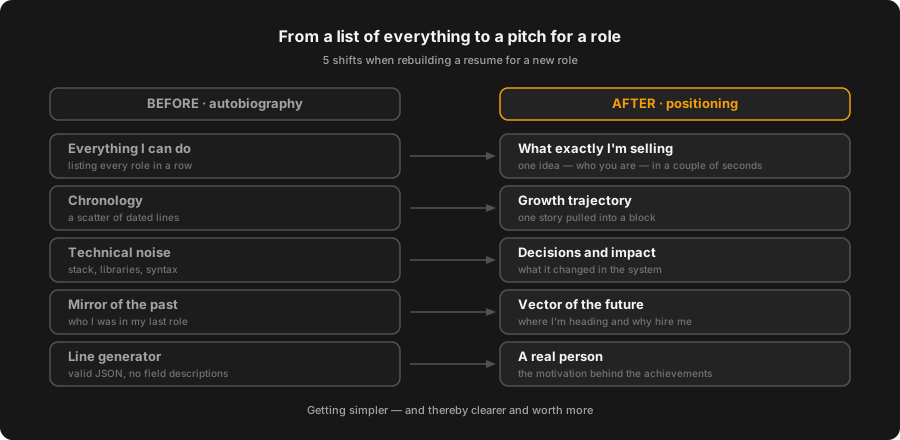
For a couple of years now I've been coaching people from all sorts of companies on their resumes, and recently I finally opened my own. The classic shoemaker with no shoes. Here's what I changed in it — and why it matters to anyone who has outgrown that old line in their profile.
Diagnosis: when a resume is too good
The consultant's job here is simple: show where a resume loses its meaning, where the living person got buried under a list of libraries and acronyms, and how to actually approach a career like a human being. Over two years a lot of other people's CVs passed through my hands. But I never got around to my own — as usually happens.
And then I did. Opened it, took a look — and got depressed. Not because it was bad. The opposite: too good. Everything was in there. Data Engineer and Project Manager, Spark and Tarantool, an analyst and a guy who, apparently, once rebuilt the cosmos from scratch. There was exactly one problem: from this document it's impossible to understand who this person is and why you'd need him. You read it — and no image forms in your head. The only thing that forms is a sense that you're looking at a very diligent list.
The funniest part — with a resume like that, I actually got invited to interviews. For CPO at a major bank. For CDO abroad — that one didn't work out, though: my English is, let's say, "very good, but not fast." So it worked even like this. But it worked in spite of itself, not because of it. So I sat down to redo it.
Below are the five things I changed. I don't claim to hold the ultimate truth, but if you've also outgrown your old role and are still dragging around a resume from five years ago — I'd suggest thinking through each point.
1. Decide who you are
A resume isn't an autobiography. It's a positioning tool. The question it should answer isn't "everything I can do," it's "what am I selling."
The difference is huge. An autobiography honestly lists everything that happened to you. Positioning chooses — and cuts. If you grew from an analyst into a manager, you can safely throw out half the verbs — "developed," "analyzed," "tested." In their place: "led," "built," "rolled out," "scaled."
The only condition is that it has to be true. I'm firmly against painting yourself a biography that never happened: in the first real interview, that gets exposed in fifteen minutes, and from there the conversation is no longer about your experience but about why you dressed it up. Positioning isn't about lying. It's about choosing which of your real roles to show first.
The person reading your resume spends a few seconds on the first pass. In those seconds they need to catch one thought: who you are. If they don't catch it — they don't dig deeper, they just close the tab.
2. Group your experience into logical blocks
Five years in one ecosystem isn't five different projects. It's one story of growth. And in most resumes it gets broken into a scattering of separate dated lines, from which the reader is supposed to assemble the puzzle themselves. Spoiler: nobody's going to assemble it.
I pulled all my experience within a single technology group into one block — with a clear trajectory: "came in for this role, grew into that one, was responsible for exactly this." Instead of a chronology where every year looks like a separate job, you get momentum: you can see how the person grew, what they took responsibility for, where they were headed.
Group experience by companies and milestones, not by dates. People buy trajectory, not chronology. Chronology answers the question "when." Trajectory answers "which direction are you developing in" — and that's exactly what matters to the person deciding whether to hire you.
3. Cut the technical noise
A CDO doesn't care which libraries you imported. A CTO isn't sweating your SQL syntax. What they care about is what you changed in the system with it.
Let me spell it out. The line "set up replication" says nothing — it's just the fact that you pressed some buttons. But "removed the single point of failure that kept taking the service down" — that's about the effect. The first describes an action, the second describes a result. People hire for the second.
Write about decisions and their consequences, not about frameworks and console commands. And keep the positioning point in mind: the resume has to be in harmony with it. If you're selling yourself as a manager, and then comes a three-screen tech stack — those three screens work against you. They scream "I'm still first and foremost an engineer" precisely when you're trying to say the opposite.
This doesn't mean you should hide your technical experience. It means you need to translate it from the language of tools into the language of effects. Not "what I used," but "what changed because of it."
4. Show a vector, not a mirror
A good resume isn't a mirror of the past, it's a vector into the future. From the first lines it should be clear where you're looking: CPO, Head of Analytics, CTO — anyone at all, but not "everything at once."
I get it, this is the hardest point. To name one direction is to close off the rest, and closing doors when the market is stormy feels psychologically uncomfortable. It seems like "versatility" widens your funnel. In reality it narrows it: if you didn't say who you want to be, the reader will decide for you — and by default will file you into the same box as your last job title. In other words, your past gets chosen for you.
A vector is a claim. You're saying: this is where I'm going, and this is why I'm worth taking there. Even if it's ambitious. A resume without a claim is just an archive, and archives don't light anyone up.
5. Add a bit of the human
And the last thing. Without lived experience behind it, the phrase "leadership skills" is just words that show up in every other CV. But a couple of honest sentences about what actually drives you works wonders.
Without that, even a perfectly assembled resume looks like JSON with no field descriptions: technically it's all valid, the structure is correct, but it's impossible to understand what entity you're looking at. The human detail is that very field comment that turns a set of values into someone alive.
You don't need to turn your resume into a confession. It's enough to show that behind the list of achievements stands a person with motivation, not a line generator.
The bottom line
I fold my experience into one block, tune the positioning toward a manager, strip out the extra noise. I become simpler — and, oddly enough, because of that, clearer and more expensive. Because now the resume holds not just a stack, but a fundamentally different take on what I used to do: not a list of tasks, but a story about where all of it was leading.
The moral is simple: once every year or two it's worth opening your own resume not as an applicant tacking on a new line, but as a consultant looking at someone else's document. An outside view is the one thing this genre is chronically missing.
P.S. This is my personal opinion, and it may well not match reality — with the exception of the positive cases of the folks I helped.
Originally published on my Telegram channel @it_underside.
Yours, DPUPP
Related Articles
The Shoemaker With No Shoes: How I Rebuilt My Own Resume
For two years I've been fixing other people's resumes — then I opened my own and got depressed. Five things I changed, and why it matters to anyone who has outgrown their old role.
Cooperative vs Employment: A Conversation the Community Was Ready to Have
Notes from conversations with RAD-KOP, a Russian cooperative IT community. Not 'here's my pitch' but 'here's where the dialogue took us': a comparison of models, real-world examples, and an honest look at the downsides.
The Value We Create — and Almost Never Keep for Ourselves
In IT we create value every single day: we fix prod, cut risk, clear out the chaos. Yet almost none of us actually owns the result. A look at an uncomfortable paradox — without the drama.